Early Intervention
For Insurers
Refer early, engage early, achieve optimised outcome. See how HCB Group understand this process and have proven its effectiveness with results.

Employee Health Management
For Employers
Combining absence management, early intervention, case management and rehabilitation. See how HCB Group are out to redefine Occupational Health Services!
Welcome to HCB Australia
HCB Group has been supporting disability insurers and employers internationally since 1984. HCB Group have a proven outcome and customer service record and we are proud to have built a market leading reputation which is underpinned by client relationships, integrity and reliability. HCB Australia launched in 2021. HCB Australia leverages the HCB Group skills and experience and brings a new dynamic to the Employee absentee management market and the Insurer, Group scheme Income Protection market.
HCB Australia’s mission is to Redefine Occupational Health. Our aim is to change the mind-set relative to what a fully integrated holistic and outcome focused Occupational Health provider can deliver. Rather than the traditional ‘medical model’, HCB Group’s approach blends compassion and common sense and draws on rigorous scientific research, which is constantly refined and updated.
HCB Clinicians look to engage your employee before an absence has occurred and where it has, then as close to day 1 of the absence as possible, and working collaboratively with our clients can and does achieve this, invariably averting an absence from occurring in the first instance.
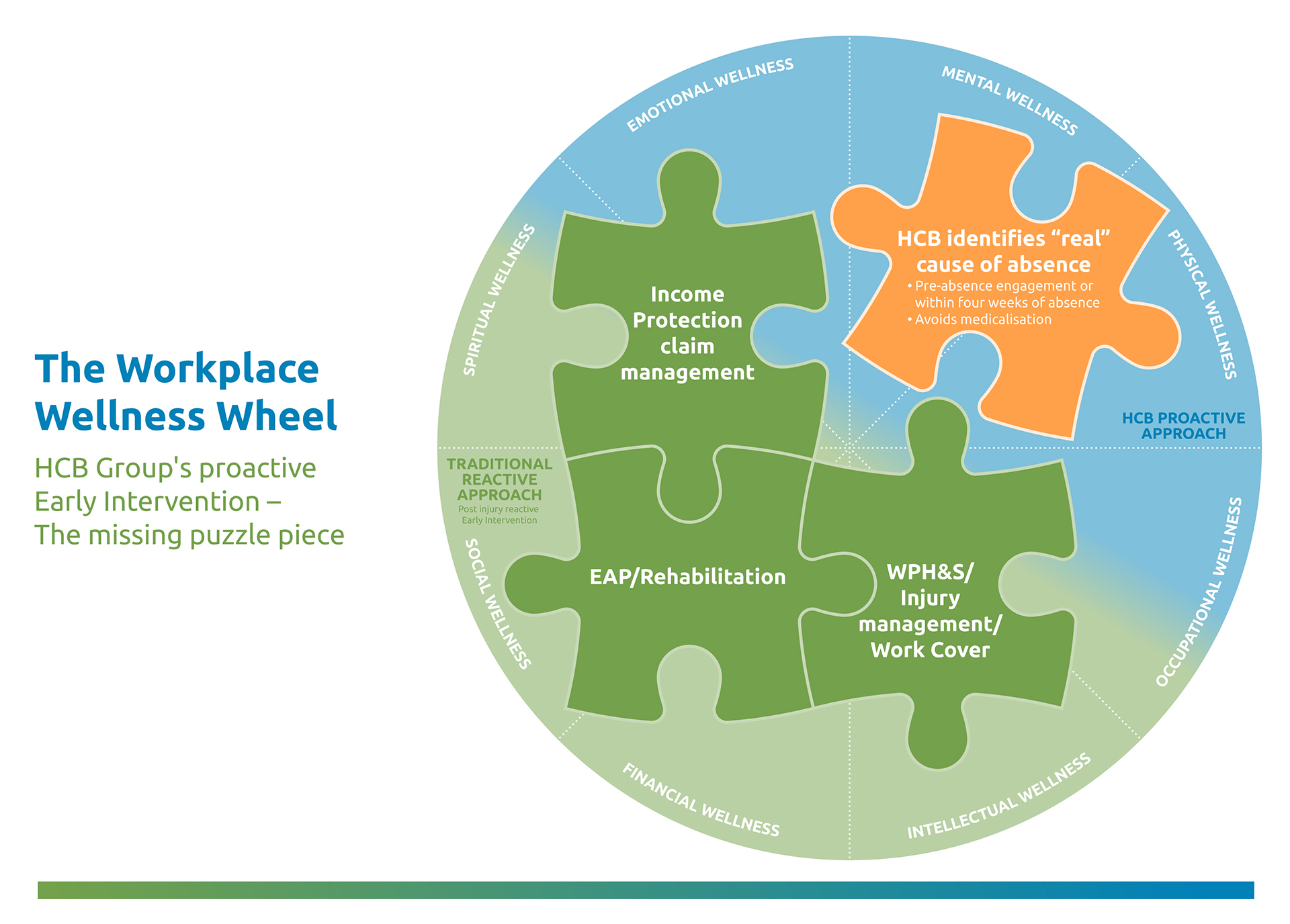
Wellness at Work, Absence Management, Early Intervention and Rehabilitation are crafted into a humanised, seamless, integrated and collaborative client service. HCB Group knows based on our own research and experience that most sickness absence arise from social rather than medical determinants. Our research is underpinned by the works of our late Director, the eminent Sir Mansel Aylward CB.
HCB Group’s focus is on the absentee with the Clinical Case Manager engaging positively with them in the capacity of a nurse led “clinical concierge”, identifying and dismantling both stay at work and return-to-work barriers, and working with the employee and their employer to agree a sustainable return to work plan that works for all stakeholders. HCB Group deliver a unique, single point of contact and collaborative service that works in concert with existing services that the employer already has in place and ensures a humanised approach, more readily trusted and embraced by employees.
Based on HCB Group’s experience, we know that if absentees are referred within 4 weeks, the fully adopted HCB Group model can achieve outcomes in up to 90% of cases managed – where referrals are made 26 weeks or more after date first absent, <5% of absentees are ever likely to return to work.
HCB Group’s pioneering work in this area has been customised to meet the needs of Australian insurers, employers, and employees.


Tailored support
Based on our experience we know that every client is different. Insurers have very different claims philosophies, and employers have different cultures, some supportive and paternalistic, and others are more rules based.
For this reason, HCB Group has learned to deliver the same outcome focused service, but carefully nuanced to blend with the culture of the organisations we support.
See what separates us from our competitors, by reading a little about The Science Behind the Service below.
Need proof that Early Intervention works?

The Science Behind the Service
HCB Case Managers are laser-focussed on sustainable outcomes. Their work is underpined by three pillars, which combine to make HCB South Africa a unique provider of Employee Health Management Systems.
Understand the Cause
BPS
Granular understanding and use of the BPS Model of Disability Assessment. Training delivered to HCB clinicians designed by one of the original architects of the BPS model, and Director of HCB, the late Professor Sir Mansel Aylward CB. This enables our CCM’s to understand the prominence of Biological, Psychological and Social factors influencing RTW at core level.
Control Duration
ODG
HCB uses world leading disability duration guidelines to aid target RTW dates, provide details on likely co-morbidities and help keep absentees motivated and driven towards sustainable RTW. These guidelines are particularly useful where MSK or other objectively diagnosable conditions are encountered.
Communicate Positively
Communicate to Influence
A training module delivered by HCB Group in partnership with its Australian based owners, combining nudge theory, brain science and motivational interviewing techniques to enable our clinicians to deliver better outcomes and improve relationships through improved understanding of how to handle challenging conversations.
What is the ‘BioPsychoSocial (BPS) Model’?
People talk in general terms about the BPS model, that taken literally to mean understanding whether a condition resulting in absence from the workplace is the result of a biological, psychological or socially determined condition.
HCB’s unique understanding and deployment of the BPS model starts right at the beginning, at the very first engagement with an employee. At this point, it is necessary that we Determine the real Cause of absence – this enables us to only deploy the expensive and precious ‘medical model’ where we are sure there is a medical condition to treat!
Biological conditions are easy. They can generally be quickly and efficiently diagnosed by a clinician, and treatment pathways are available. HCB works with employees towards understanding and managing absence duration in this type of case, often supported by established disability duration guidelines which help us case manage treatment to ensure a timely return to work.
Psychological conditions are more tricky because some of them are largely self-reported and subjective. Again, either as a result of clinical diagnosis, or HCB early intervention, these conditions can be identified and steps taken to implement appropriate treatment / signposting as the earliest possible time. Of course, there is an inherent danger to delayed engagement where Psychological issues prevail, and these conditions can be expected to worsen over time where unresolved. Another good reason for utilising HCB’s early intervention services.
Socially determined absence can be attributed to a significant and increasing number of workplace absences. There is evidence that as much as 70% of sickness absence is socially determined and often wrongly medicalised by the medical profession. For this reason, HCB invest significant time and effort at the initial engagement with absentees to identify those cases which are actually socially determined, which enable our clinicians to (a) avoid deployment of the medical model where there Is no medical condition to treat, and (b) identify the real barriers preventing the person from returning to work, and using appropriate resource and support to help dismantle those barriers in pursuit of a meaningful outcome for all stakeholders.
To demonstrate the value that HCB delivers to clients, the video below was created collaboratively by HCB, the Insurer and the Employer of the person that HCB supported. The video provides insight into HCB's unique proposition and the journey experience for the individual at the heart of our service. We will be delivering this unrivalled level of support to HCB clients globally.
News

HCB Group appoints new Chief Medical Officer
HCB has appointed Professor Stoffel Grobler as Chief Medical Officer across HCB Group, assuming More

Financial Services firms to tackle employee wellbeing challenges
HCB Group UK have shared this article from the UK Insurance trade More
Eoin Byrne, Chairman, HCB Australia says;
“HCB Group are excited to be bringing HCB to Australia to be able to deliver person-centred care through the provision of tailored support to our customers. We recognise the health benefits of purpose-filled work and we will work closely with both employers and employees to provide a prompt remain at work or return to work solution when they need it the most.”
$61 billion
The cost of work-related injury and disease to the Australian economy
We're international
HCB's dream to provide services internationally becomes a reality

United Kingdom

Ireland

Australia